- Eggbun's Newsletter
- Posts
- Eggbun Newsletter!
Eggbun Newsletter!
🎵 Tips & Guides for Pronuncation, Webtoon, memes and more! 🎵

Eggbun Education
January 15, 2024
🎵 Tips & Guides for Mastering Korean Pronunciation 🎵
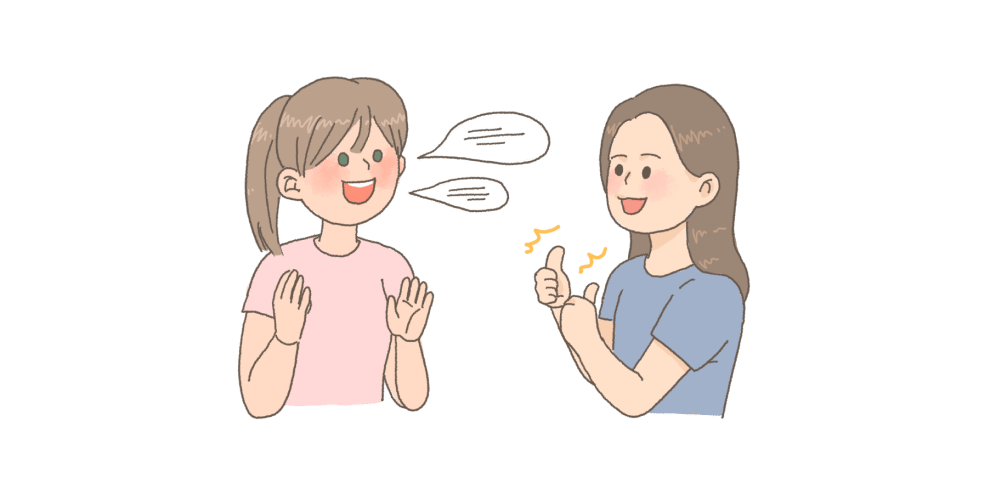
Embarking on the Korean language journey often brings excitement and challenges, especially when it comes to mastering its unique pronunciation. In this edition, we'll explore common pronunciation hurdles and provide effective strategies to overcome them.
🔍 Understanding Korean Pronunciation Difficulties 🔍
1. Consonant Clusters:
Korean has consonant clusters that might be unfamiliar to learners. Words like "학교 (hak-gyo)" or "박사 (bak-sa)" can pose challenges due to consecutive consonant sounds.
2. Aspiration and Tension:
Differentiating between aspirated and unaspirated sounds, like "ㅂ (b)" and "ㅍ (p)," or "ㄷ (d)" and "ㄸ (t)," requires attentive practice to grasp the nuances.
3. Vowel Sounds:
Mastering the subtle differences in vowel sounds such as "ㅓ (eo)" and "ㅗ (o)" or "ㅡ (eu)" and "ㅜ (u)" is crucial for accurate pronunciation.
4. Intonation and Stress:
Korean has its own rhythm and stress patterns. Understanding how stress affects meaning and clarity in sentences is vital.
🌟 Practical Tips and Guides for Pronunciation Practice 🌟
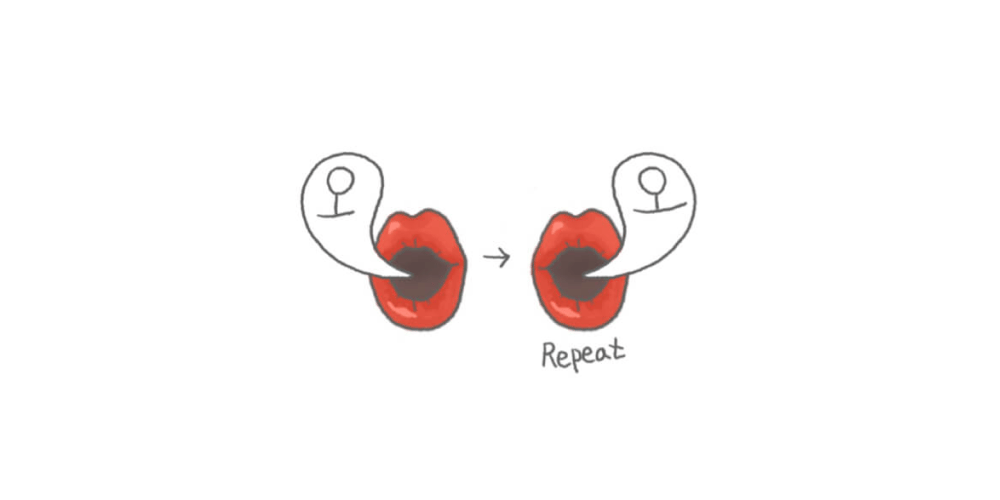
Mimic Native Speakers:
Listen closely to native speakers through K-dramas, music, or language learning apps. Mimic their pronunciation, intonation, and rhythm to enhance your own speaking skills.Tongue Twisters and Rhymes:
Engage in tongue twisters and rhymes to practice tricky sounds and improve tongue flexibility. Challenge yourself with phrases like “내가 그린 기린 그림은 긴 그린 그림이고, 니가 그린 기린 그림은 안 긴 기린 그림이다.” “간장공장 공장장은 강공장장이고, 된장공장 공장장은 장공장장이다”Record and Self-Evaluate:
Record yourself speaking Korean phrases or sentences. Listen back and compare your pronunciation with native speakers. Focus on areas needing improvement.Tongue Positioning Exercises:
Practice the correct tongue positioning for challenging sounds by using guides or tutorials available online. Consistent practice will enhance your articulation.Language Exchange and Feedback:
Engage in language exchange with native speakers. Seek feedback on your pronunciation and ask for guidance on improving specific sounds.
Remember, mastering Korean pronunciation is a journey, not a race. Embrace the process, celebrate progress, and enjoy the beauty of expressing yourself in this melodious language.
Wishing you joyful and fruitful strides in your Korean language endeavors!
Warm Regards,
🎞️ Learn Korean through webtoons with Eggbun! 🎞️
아빠는 N살 (Dad is N years old)
N years since I’ve become a dad, N years living as a dad.
EP 1. 아빠, 어디 아파? Dad, are you hurt somewhere?
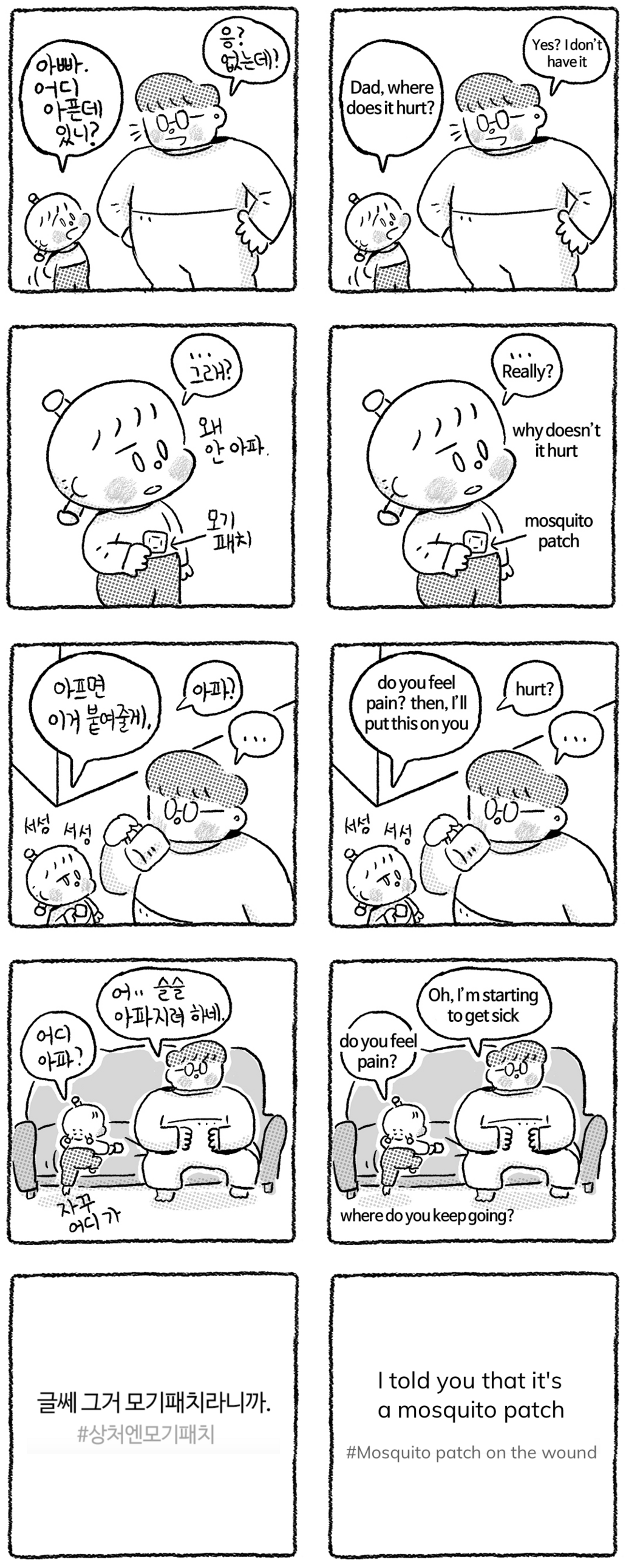
Word list:
아빠: dad
어디: where
아프다: to be sick
모기: mosquito
패치: patch
붙이다: to attach
상처: wound
슬슬: slowly
🔥 The hottest Korean slang in 2023 <T발 C야?> 🔥
During the height of the MBTI (Myers-Briggs Type Indicator) trend, it became common to ask, "What's your MBTI?" when meeting new people.
A recent trend in MBTI-related slang is the phrase "T발 C야?" which may initially seem like a typo but is actually a rising expression.
The T refers to thinkers with a logical orientation, as revealed in MBTI results. Those with a T orientation tend to respond to situations with practical answers and actions. But that may feel like less emotionally empathetic than F orientation tend. People ask, "너 T야?(Are you T in MBTI?)" when people with a T personality poke fun at their lack of empathy.
For example, if a friend has a car accident, a T-oriented person might ask about insurance, contact details, and the steps taken to handle the situation.
Conversely, individuals with an F orientation, characterized by a focus on feelings, might respond with empathy and concern for the other person's emotions.
Interactions between F and T individuals can lead to misunderstandings, with F seeking emotional connection and T providing practical solutions.
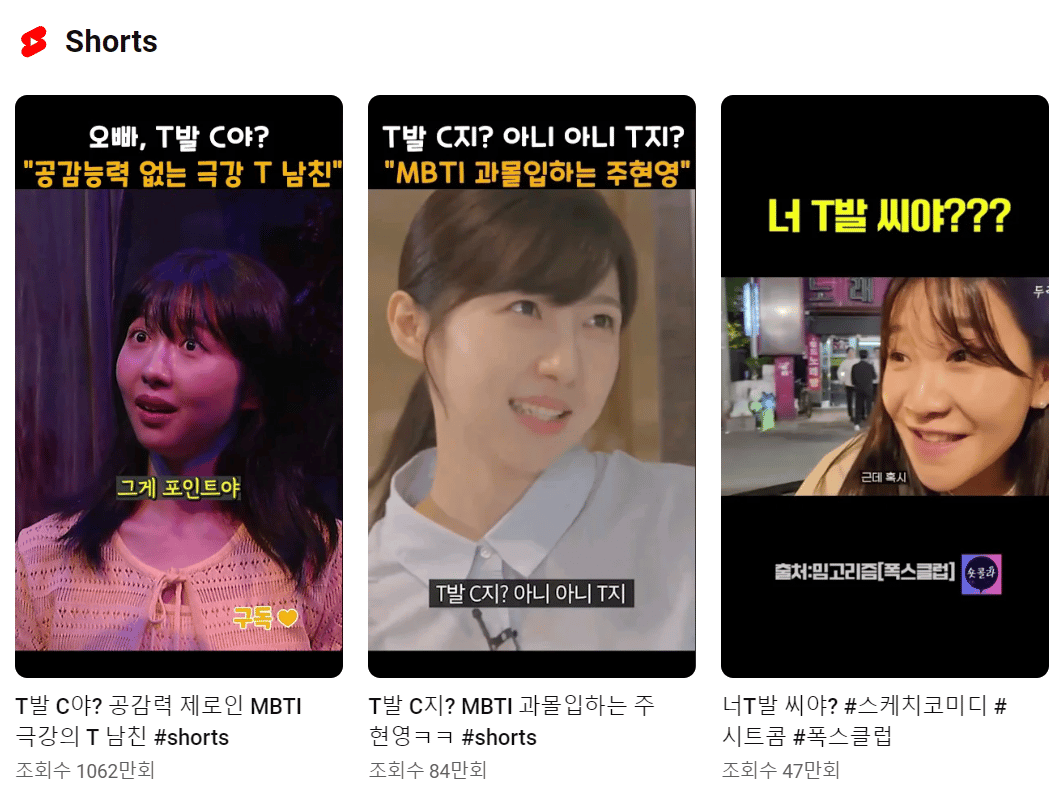
The phrase "T발 C야?" stems from reactions to such practical responses. It sarcastically turns the compliment "Your response is efficient."
In this phrase, the positions of T and C are intentionally switched. The *발 is a typical Korean swear word, so it should be careful when using it as it can be offensive to others.
Would you like to continue receiving our newsletter?